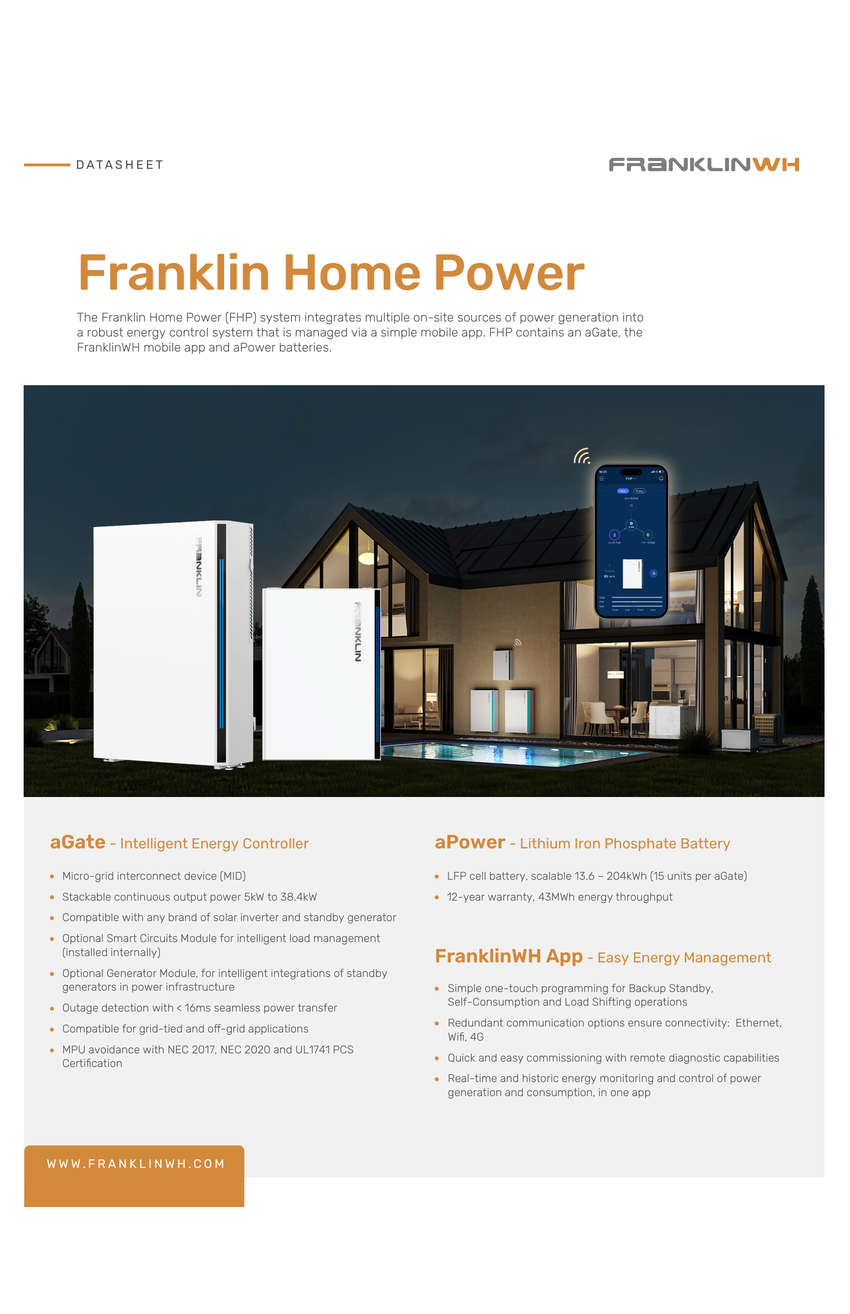
FranklinWH Home
The FranklinWH Home Power system is an intelligent residential energy storage solution designed to provide reliable backup power, maximize solar energy utilization, and increase energy independence. The system combines the aGate Intelligent Energy Controller, aPower lithium iron phosphate (LFP) batteries, and the FranklinWH mobile application into a single energy management platform capable of integrating utility power, solar photovoltaic (PV) systems, battery storage, and compatible standby generators.
During normal operation, the system stores excess solar energy or utility power for later use while continuously monitoring household energy production and consumption. In the event of a utility outage, the aGate controller automatically detects the loss of power and transfers the home to backup operation in less than 16 milliseconds, helping maintain continuous operation of critical household loads. The FranklinWH App provides real-time monitoring, remote diagnostics, backup configuration, self-consumption, and load-shifting control from a mobile device.
Each aPower battery provides 13.6 kWh of usable energy and utilizes Lithium Iron Phosphate (LFP) battery chemistry for enhanced safety, long service life, and thermal stability. The system is expandable to 15 battery units per aGate, allowing homeowners to increase both energy storage capacity and backup duration as their electrical demands grow.
The FranklinWH Home Power system is listed for both indoor and outdoor installation and features a NEMA 3R enclosure, IP67-rated battery enclosure, AC-coupled architecture, and compatibility with virtually any major brand of solar inverter and many standby generators. The system complies with major North American safety standards, including UL 9540, UL 9540A, UL 1973, UL 1741 SA/SB, IEEE 1547, and related certifications for residential energy storage systems.
Installation shall be performed by qualified personnel in accordance with the manufacturer's installation instructions, applicable local building codes, utility interconnection requirements, and the National Electrical Code (NEC), including but not limited to Articles 690 (Solar Photovoltaic Systems), 705 (Interconnected Electric Power Production Sources), 706 (Energy Storage Systems), 710 (Stand-Alone Systems), and all other applicable provisions. Proper commissioning, programming, utility approval, and final inspection are required before the system is placed into service.