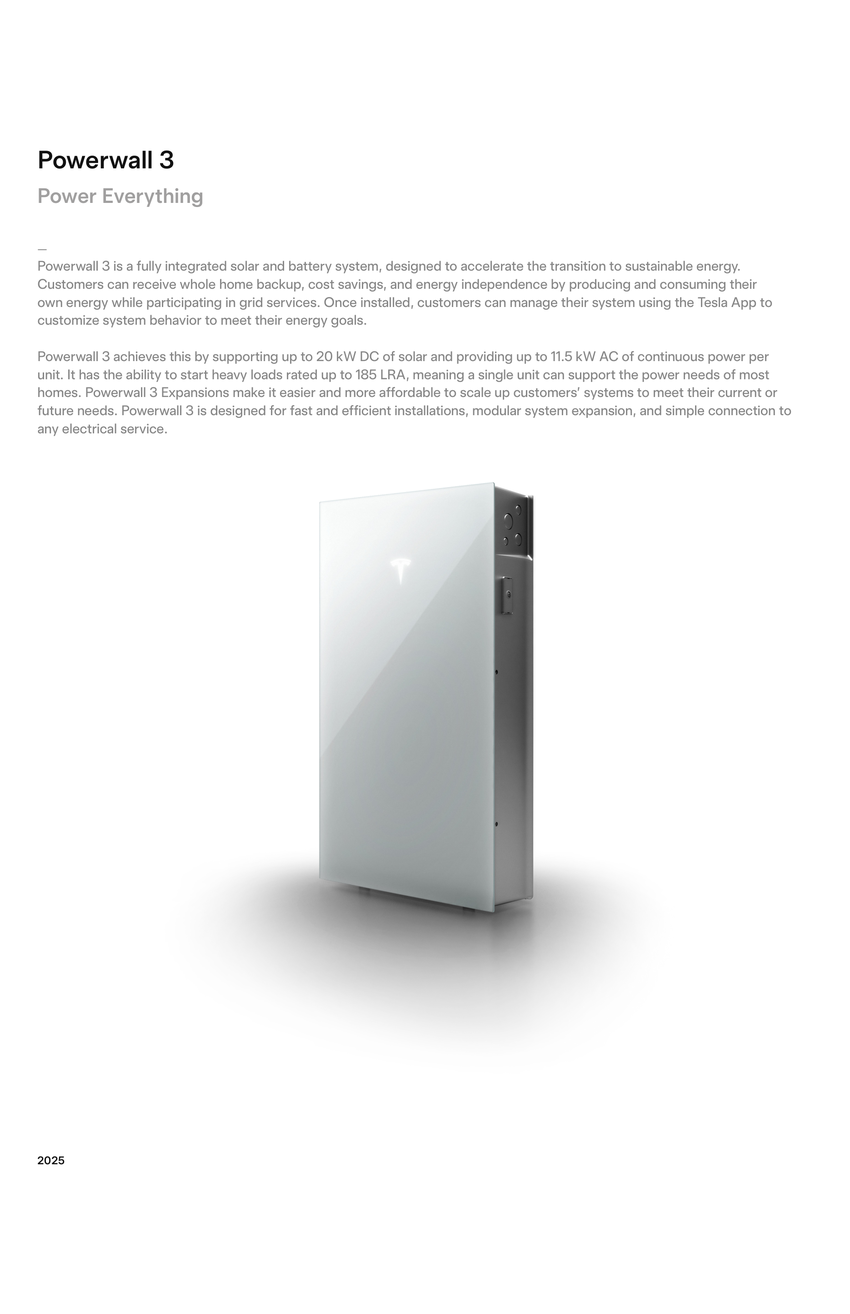
Tesla Powerwall
The Tesla Powerwall 3 is an advanced residential battery energy storage system designed to provide reliable backup power, maximize solar energy utilization, and increase energy independence. Combining a high-capacity lithium-ion battery with an integrated solar inverter, Powerwall 3 delivers seamless backup power during utility outages while intelligently managing energy production and consumption throughout the day.
During normal operation, the system stores excess energy produced by a compatible solar photovoltaic (PV) system or charges from the utility grid based on the homeowner's energy management strategy. In the event of a power outage, Powerwall 3 automatically detects the interruption and transitions to backup operation within seconds, helping maintain power to essential circuits or the entire home, depending on the system design. System monitoring, operating modes, energy usage, and backup status are managed through the Tesla mobile application.
Each Powerwall 3 provides 13.5 kWh of usable battery storage, supports up to 20 kW of DC solar input, and delivers up to 11.5 kW of continuous AC output, allowing a single unit to start and operate many of the high-demand electrical loads commonly found in residential applications. The system is modular and may be expanded with additional Powerwall 3 or Powerwall Expansion units to increase both backup capacity and stored energy as the homeowner's needs grow.
Powerwall 3 is listed for both indoor and outdoor installation, features a NEMA 3R enclosure, IP67-rated battery and power electronics, integrated arc-fault protection, rapid shutdown capability for photovoltaic systems, and is certified to major North American safety standards, including UL 1741, UL 9540, UL 9540A, UL 1973, IEEE 1547, and other applicable standards for energy storage systems.
Installation shall be performed by qualified personnel in accordance with the manufacturer's installation instructions, the applicable local building codes, utility interconnection requirements, and the National Electrical Code (NEC), including but not limited to Articles 690 (Solar Photovoltaic Systems), 705 (Interconnected Electric Power Production Sources), 706 (Energy Storage Systems), 710 (Stand-Alone Systems), and all other applicable provisions. Proper commissioning, system configuration, utility approval, and final inspection are required prior to placing the system into service.